A product design case study · concept project

A product design case study · concept project

Building Trust into Valet Parking

Building Trust into Valet Parking

Handing your keys to a stranger feels like a gamble. I redesigned that moment around one idea, a shared, trusted record of your car's condition and custody.

Handing your keys to a stranger feels like a gamble. I redesigned that moment around one idea, a shared, trusted record of your car's condition and custody.

ROLE

Product Designer

TIMELINE

1 Week

TL;DR

Overview

The Problem

Guests using valet services at a commercial place feel uncertain after handing over their car due to a lack of transparency and accountability.

The Solution

A transparent valet journey with documentation, live status, and valet ratings builds trust from handover to retrieval.

The Impact

Reduced guest anxiety, faster pickups, fewer support queries, and greater accountability for valet teams.

Context

I chose this challenge because it focuses on an overlooked experience where trust is critical, yet digital products have done little to improve it. It offered an opportunity to design for confidence rather than just convenience.

The brief

Customers using valet parking at shopping centers and restaurants feel anxious about the security and treatment of their vehicles. They get no transparency about where their car is parked, can't monitor it remotely, and hear stories of valets taking cars for personal use.

I separated what I actually knew from what was being assumed:

  • Known: People feel anxious. (The symptom.)

  • Assumed: It's because they can't see the location or monitor the car.

Those assumptions became things to test, not facts to build on.

Research

I tried to understand current behavior of guest and valets in commercial spaces and how/when anxiety played a part in the whole user journey.

I tried to understand current behavior of guest and valets in commercial spaces and how/when anxiety played a part in the whole user journey.

Methodology - I collected and analyzed valet experiences/reviews online and talked to few neighbors which have used valet service before.

Methodology - I collected and analyzed valet experiences/reviews online and talked to few neighbors which have used valet service before.

Pain points

Items inside the car were stolen or gone through

Valets damaging the car and then disowning it — "that scratch was already there"

Valets misusing the car — joyriding, driving it rough

Keys lost or stolen; cars taken

General distrust from stories heard, even with no personal bad experience

Parking location not communicated (mentioned — but rarely, and mildly)

Items inside the car were stolen or gone through

Valets damaging the car and then disowning it — "that scratch was already there"

Valets misusing the car — joyriding, driving it rough

Keys lost or stolen; cars taken

General distrust from stories heard, even with no personal bad experience

Parking location not communicated (mentioned — but rarely, and mildly)

Insights

1 . Getting the car back is slower than expected.

The pickup wait itself is a real source of stress, not just a minor annoyance.

2 · Anxiety isn’t constant, it spikes twice

Mapped onto a timeline, the fear isn’t spread evenly. It’s planted at handover (no record exists yet) and harvested at retrieval (damage discovered, disputes, the wait).

3 · Speed kills inspection.

25 cars in 45 minutes means careful checks drop to zero. Even valets who want to do it right physically can't.

Who I’m designing for

The anxious guest

Hands over the car, wants to feel it’s in safe hands, and above all doesn’t want a fight at pickup.

“I just want my car back the way I gave it — and I want proof if it isn’t.”

The valet

Moving fast, one phone in hand, 50 cars in 45 minutes. Won’t use anything that slows them down.

“I want to prove I didn’t cause that damage — but I don’t have 3 minutes per car.”

The manager

Carries the cost of every dispute and every bad review, and can’t watch every attendant.

“I need to know which of my people I can trust.”

What already exists (and where it breaks)

Other similar softwares

Other similar softwares

Pros

  • Creates a real paper trail (timestamped photos + condition logs).

  • Records matched at retrieval.

Cons

  • Documentation gets skipped during the 45-min rush.

  • Records disputes but doesn't resolve them.

  • Does nothing for the guest anxious before drop-off.

  • Misses interior, valuables, and keys.

Solution

Just after handover, the first screen guest sees (via a webapp) explains clearly how the system protects their car.

The solution

Problem 1

One shared, trusted record that travels with the car

Users lack a clear understanding of the valet process before handing over their vehicle, leading to confusion, anxiety, and reduced trust.

Clear explanation of what the valet/system process and which information is available, this transparency builds trust with the guest just after handover

Guest process acknowledgement

Problem 1

Users lack a clear understanding of the valet process before handing over their vehicle, leading to confusion, anxiety, and reduced trust.

Solution

Just after handover, the first screen guest sees (via a webapp) explains clearly how the system protects their car.

Clear explanation of what the valet/system process and which information is available, this transparency builds trust with the guest just after handover

Clear explanation of what the valet/system process and which information is available, this transparency builds trust with the guest just after handover

Guest process acknowledgement

Problem 2

Guests have no visibility into where their vehicle is after handover or how much time it will take to recall it. This uncertainty leads to anxiety and longer perceived retrieval times.

Solution

Provide real-time vehicle status updates throughout the valet journey (Being Parked → Parked → Arriving → Arrived), along with an estimated retrieval time. This will be marked by the valet as he/she parks the vehicle.
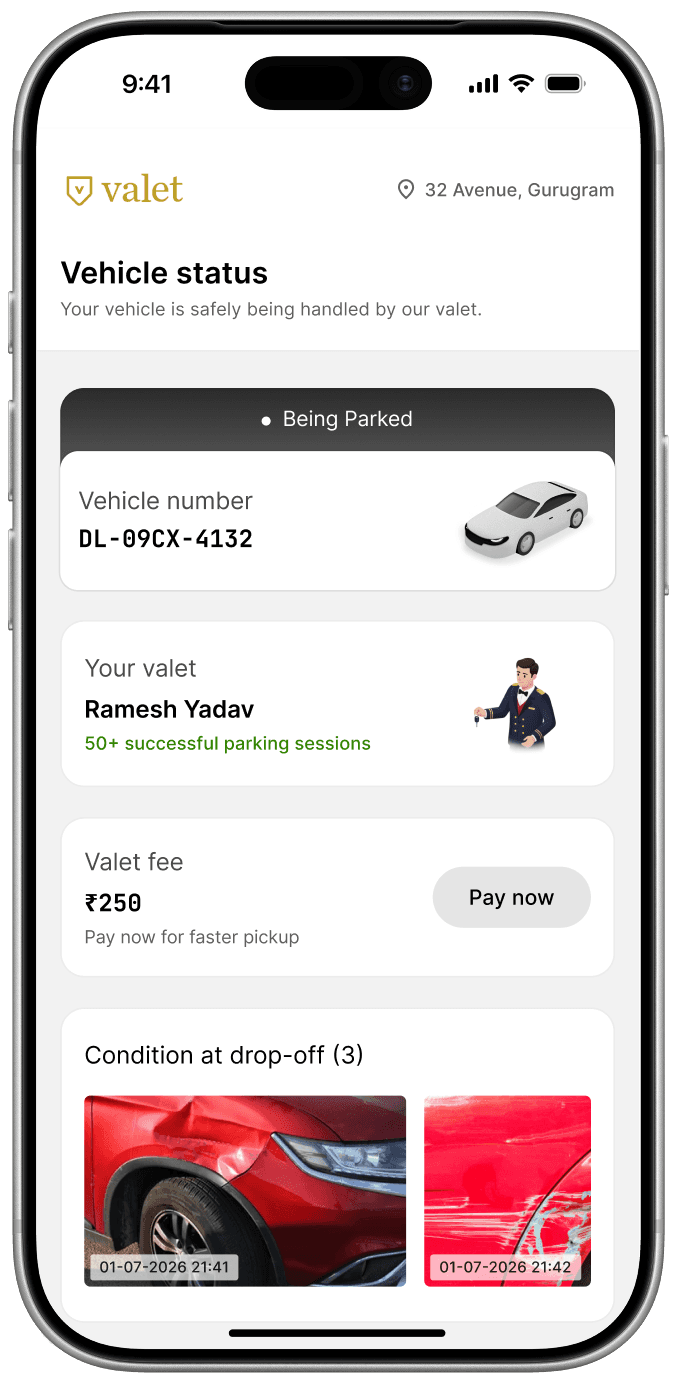
Continuous visibility reassures guests, reduces uncertainty, and sets clear expectations during pickup.

Continuous visibility reassures guests, reduces uncertainty, and sets clear expectations during pickup.

Live status variants

Problem 3

Guests have no information about who is handling their vehicle, making it difficult to trust the valet service. At the same time, valet managers lack clear visibility into individual valet performance, allowing repeat offenders or poor service patterns to go unnoticed.

Solution

Display a valet trust profile that includes ratings, service history before vehicle handover. Behind the scenes, track valet performance over time to help managers identify repeat offenders, reward reliable staff, and improve accountability across the service.

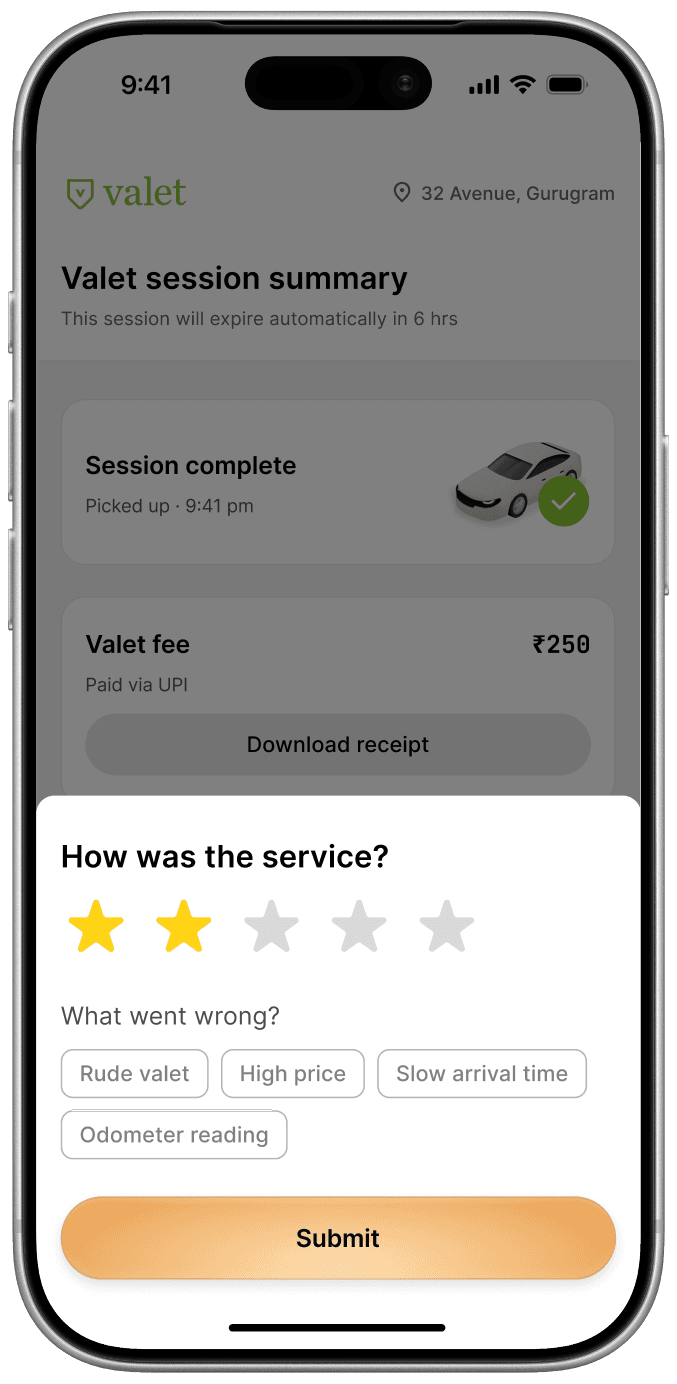
Guest side only sees the experience and name of the valet.

vs

The manager monitors ratings and feedback by the guests.

Guest side only sees the experience and name of the valet.

vs

The manager monitors ratings and feedback by the guests.

Low rating prompts common reasons from guest to choose from

Low rating prompts common reasons from guest to choose from

Problem 4

Guests and valet staff need a reliable and fast way to document vehicle condition during handover because disputes cannot be resolved objectively.

Solution

Capture only the dispute-prone zones, not the whole car (timestamped). Keep it one-handed and portrait, since it's a phone held while walking the car.
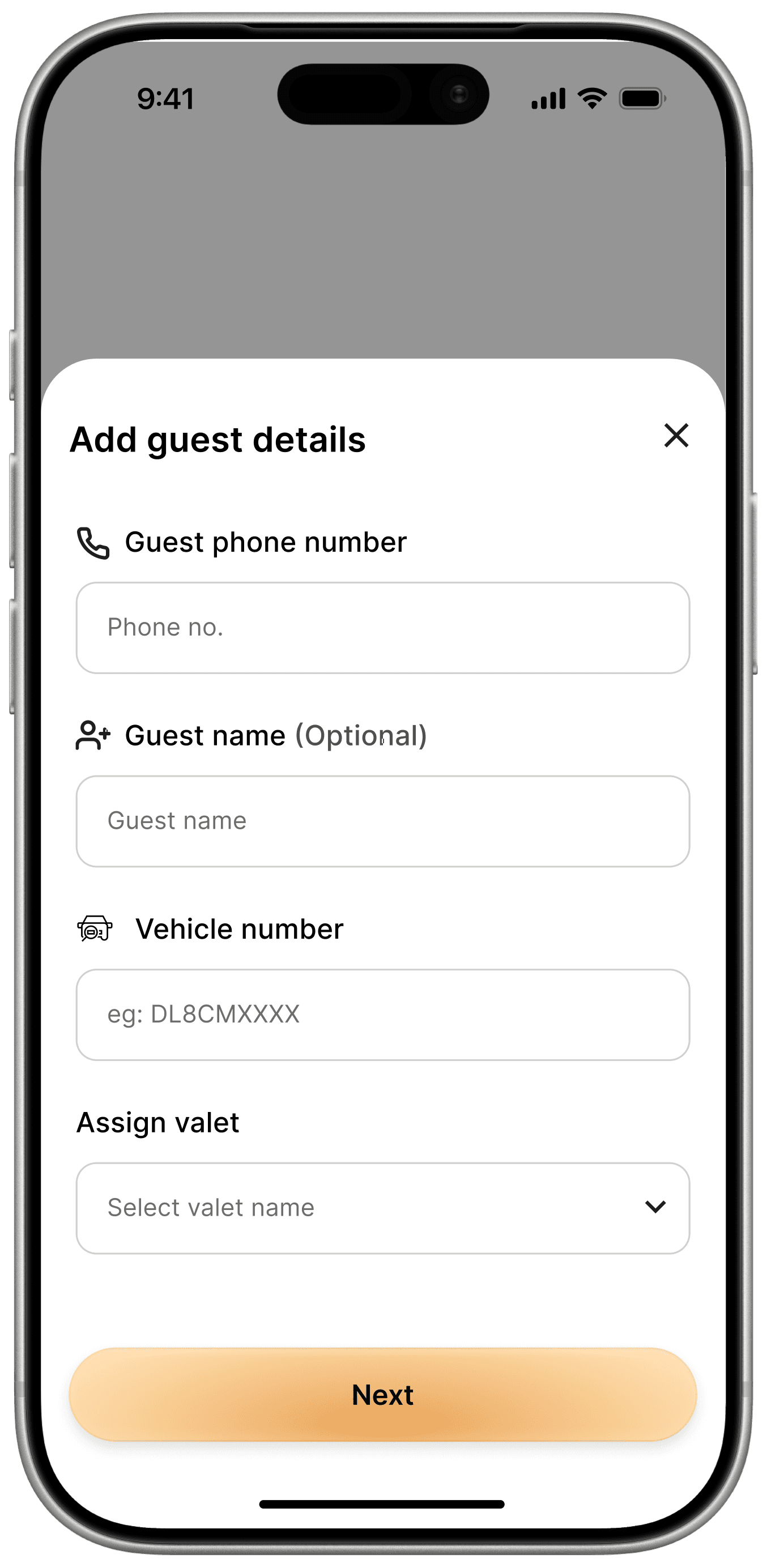
The one tension that shaped every screen

Tradeoff

Documentation quality and speed pull in opposite directions
more thorough = more trust = more time = skipped under a rush.

a timestamped record of dispute-prone zones, live status and valet feedback is a middle ground which i found.

How I’d measure success

  • Retrieval time — if my record step slows pickup, I’ve hurt the thing that makes valet viable.

  • Check frequency — if people obsessively refresh live status, that’s anxiety, not comfort.

  • Valet sentiment — if accountability feels like surveillance, adoption dies.

  • Retrieval time — if my record step slows pickup, I’ve hurt the thing that makes valet viable.

  • Check frequency — if people obsessively refresh live status, that’s anxiety, not comfort.

  • Valet sentiment — if accountability feels like surveillance, adoption dies.

What I learned

The brief is a hypothesis, not a spec. The most valuable thing I did was not build the tracking app the brief nudged me toward. Reframing location → accountability was the whole project.

Design to the constraint, not around it. The rush wasn’t an obstacle to ignore — it was the thing that made this a real design problem. “Build trust” is easy; “build trust in 10 seconds during a 50-car rush” is a brief.

Two-sided problems need two-sided design. Most valet concepts design a pretty guest app in a vacuum. Designing for the valet’s speed and the guest’s calm at the same time is where the actual difficulty — and the differentiation — lives.

What I’d do next: validate the “good enough” documentation threshold with real valets under real rush conditions, and pressure-test whether guests actually trust a rating or need something more concrete.

The brief is a hypothesis, not a spec. The most valuable thing I did was not build the tracking app the brief nudged me toward. Reframing location → accountability was the whole project.

Design to the constraint, not around it. The rush wasn’t an obstacle to ignore — it was the thing that made this a real design problem. “Build trust” is easy; “build trust in 10 seconds during a 50-car rush” is a brief.

Two-sided problems need two-sided design. Most valet concepts design a pretty guest app in a vacuum. Designing for the valet’s speed and the guest’s calm at the same time is where the actual difficulty — and the differentiation — lives.

What I’d do next: validate with real valets under real rush conditions, and pressure-test whether guests actually trust a rating or need something more concrete.

Create a free website with Framer, the website builder loved by startups, designers and agencies.